The Western Australian Museum and the Foundation for the WA Museum are delighted to celebrate a major scientific milestone with the discovery of nine new species of sea stars from the mesophotic zone of Ashmore Reef, in the north-eastern Indian Ocean.
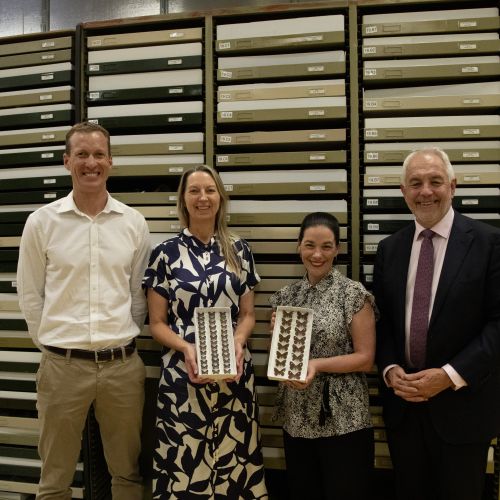
The discoveries form part of a substantial taxonomic study led by Dr Christopher Mah, a globally recognised starfish expert who spent time in the WA Museum collections in 2024 as part of a Fellowship program funded by the Foundation for the WA Museum and recently published in the journal Megataxa.
Dr Mah’s deep-sea research spans Antarctica, the Pacific and beyond, earning international recognition for documenting echinoderm diversity and bringing new species to science. Through this work, he has formally described nine new species, with a further taxon currently in progress, and recorded sixteen sea star species in Western Australia for the first time.
Collectively, these discoveries represent a significant expansion of scientific knowledge, deepening our understanding of marine biodiversity in this region and reinforcing Western Australia’s importance in global ocean research.
The specimens were collected during the 2021 research expedition aboard the RV Falkor, using the remotely operated vehicle (ROV) SuBastian to explore mesophotic depths, the dimly lit zone between shallow reefs and the deep sea, revealing extraordinary species, behaviours and ecological relationships rarely observed in situ.
Among the most remarkable findings was the first-ever in situ observation of the enigmatic “soccer ball” sea star, Podosphaeraster bola, captured covered in spines and alive in its natural habitat.
Researchers also documented a striking tropical “slime star”, Euretaster magnificus, at a depth of 52 metres, displaying a distinctive marbled pattern. Similar markings have since been noted on imagery shared via iNaturalist, suggesting the species may yet be discovered in shallower waters.
The expedition revealed complex ecological interactions not typically seen in trawl-collected specimens. Several sea stars were observed in close association with scale worms, while one newly described species, Asterodiscides, was found hosting a parasitic eulimid snail burrowed into its body wall, a rare and revealing observation that offers new insight into species relationships in mesophotic ecosystems.
Further analysis suggests these mesophotic sea star species may be more widely distributed than previously thought. Observations of species such as Churaumiastra hoshi, only described in 2024, indicate faunal connections between shallow tropical reefs and deeper-sea environments, reinforcing the importance of mesophotic ecosystems as critical biodiversity bridges.
The Foundation extends its warm congratulations to Dr Mah on this outstanding achievement and thanks who made the expedition and fellowship possible. The work underscores the critical role of philanthropic investment in enabling world-class marine research and advancing knowledge of Western Australia’s unique underwater heritage.
Chris Mah will work with the Schmidt Ocean Institute to further promote the research internationally, with opportunities for the WA Museum and the Foundation to support and amplify its impact.